

Recycle This Book: 100 Top Children’s Book Authors Tell You How to Go Green
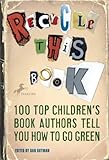
- ISBN13: 9780385737210
- Condition: New
- Notes: BUY WITH CONFIDENCE, Over one million books sold! 98% Positive feedback. Compare our books, prices and service to the competition. 100% Satisfaction Guaranteed
With essays from renowned children’s book authors such as Ann Brashares, Jeanne DuPrau, Caroline B. Cooney, Laurie Halse Anderson, Bruce Coville, Gennifer Choldenko, and over 100 others, each piece is an informative and inspiring call to kids of al
Rating:  (out of 4 reviews)

List Price: $ 5.99
Price: $ 3.11
[wprebay kw=”how+to+recycle” num=”0″ ebcat=”all”] [wprebay kw=”how+to+recycle” num=”1″ ebcat=”all”]

Review by Richie Partington for Recycle This Book: 100 Top Children’s Book Authors Tell You How to Go Green
Rating:
“CAPTAIN MEAN-GREEN’S TEN RULES TO SAVE THE PLANET
By Robert Lipsyte
“Never flush the toilet.
“When it gets hot in the house, walk around naked.
“When it gets cold, take the blanket off your grandma’s bed and wear it.
“Always shut off other people’s computers, iPods, and cell phone chargers if they are not paying attention.
“Instead of stealing a car, sneak onto public transportation.
“Don’t ask for plastic or paper at the supermarket; slip food into your pockets before you get to the checkout.
“Brush your teeth every other day; wash yourself every third day.
“Use your sleeve instead of napkins.
“Scratch ‘Save the Planet’ on the hoods of SUVs.
“Write shorter sentences to save trees.
“Remember kids — while Captain Mean-Green’s rules are extreme, his message is clear: we all have to do our part to help save the environment and heal the damage that’s been done to the planet.”
RECYCLE THIS BOOK is a lively collection of essays, stories, poems, and satire in which the contributors offer recommendations on how readers can change their behavior and surroundings for the sake of Mother Earth. Many suggestions — like replacing lightbulbs and turning off the faucet while you are brushing your teeth — are really simple and are free or cost almost nothing. Others — like buying a hybrid vehicle or installing solar panels — require family decisions and capital investment but promise big savings and a significant positive impact on the world that we will pass on to our descendants.
Here’s how I propose that readers use this book. First, you can brag about ten things advocated by the authors that you already do pretty well. Here’s my list:
1. Like Lois Lowry, I have long saved energy by utilizing a clothesline to dry my laundry.
2. Like Todd Strasser, I save energy by dressing warmly and keeping my house relatively cool in the winter. (I actually don’t have any thermostats or central heating or air conditioners in my house.)
3. Like Phyllis Reynolds Naylor, I always let the sun in to heat the house. When I built the house I oriented it so as to maximize the sunlight.
4. Like Maryrose Wood, I have helped save energy and rainforests by being — for 30 years now — a vegetarian. (A couple of years ago I finally weaned myself off of dairy products and am now a vegan.)
5. Like Meg Rosoff, I cut down on my waste stream by composting all of my food scraps. And like Andrew Clements, I separate out all of the glass, cardboard, paper, aluminum, scrap metal, and plastics for recycling. By time I’m done keeping everything out of the garbage, I end up having a load to bring to the dumps about once every three or four months.
6. Like James Howe, I reuse Mason jars as drinking glasses. It is healthy to drink plenty of fluids and so I fill up a jar with water or herbal tea and keep it near me all day while I’m working. I never buy or use disposable cups at home or at work.
7. Like several authors who discuss it in their essays, I am keenly aware of the energy and environmental positions held by local, state, and national political candidates. Since my high school-during-the-Vietnam War-days, I have actively supported candidates whom I believe will make the Earth a healthier, greener, more peaceful place.
8. Like Roland Smith, I spend a lot of time walking. I am always walking around town with the dogs, and I cannot remember the last vacation or convention for which I didn’t walk many miles every day — both for transportation and for exercise.
9. Like Laurie Halse Anderson, I do my best to plan and combine errands into one trip. By refusing to give in to a whim to hop into the pickup and run into town for something that is not really necessary today, it has helped me become more organized. I have learned to keep a stash of staples so as to always have the ingredients to make something without having to drive to town.
10. Like Jerry Spinelli, I donate belongings I no longer need to thrift stores so that they can get reused — with a profit going to a good cause. When I need to buy something, I do my best to buy it used. I patronize thrift stores and the Sebastopol Flea Market. And I let my fingers do the walking on Craigslist and eBay. The next time you see me at a convention, I will likely be wearing a dress shirt from the Flea Market, a suit jacket from the Goodwill store, and a vintage Jerry Garcia brand necktie from the colorful collection of gently used ones I’ve accumulated through purchases on EBay.
The bragging is pretty easy. Now here comes the more difficult part: You try to commit to ten new things advocated by the contributors that you will begin doing, or begin doing more consistently. Here is my list of resolutions:
1. Kirby Larson has persuaded me to accumulate a stash of cloth napkins so that I can cut down on my use of paper towels.
2. Seymour Simon has me ready to change even more of my light fixtures to the compact florescent lightbulbs.
3. I’ll be recalling Eric Kimmel’s essay, “Turn It Off!” when I more consistently pull the cell phone charger out of the outlet when I unplug the phone from the charger.
4. Thanks to Katy Kelly, I have marked my calendar for Arbor Day, April 24th. The day-to-day requirements of gardening has never come natural to me, but I can easily deal with planting another fruit tree. This time, I think I’ll go for a fig tree.
5. I’m pretty media savvy, and so TV advertisements rarely have an effect on my behavior, but I like Bruce Coville’s idea of muting the commercials. I just tried it (As is typical, I’ve got the news on in the background.) and it is a pleasant respite from the noise.
6. Sonya Levitin has a great suggestion for keeping packing materials out of landfills by delivering them to a business that can reuse them. I get a lot of packing materials with the books that arrive here, so there is one idea that will make a big difference.
7. Speaking of packing materials, Lurlene McDaniel’s essay on wrapping paper has me realizing that I can put aside the paper that was padding the box in which this very book arrived yesterday. I’ll have recycled wrapping paper from now on.
8. I love Tony Abbott’s suggestion for posting “Use Less Stuff” signs around the house. (If you still have never seen “The Story of Stuff,” please please google it and watch the online video.) I’ve recycled a piece of mail to make my first “Use Less Stuff” sign which is now attached to the outlet into which I plug the cell phone charger.
9. Listening to Rich Wallace, I have hung on the door one of those cloth book bags I pick up at conferences. I resolve to keep a few of them in the pickup so that I can pass on the paper bags when I’m at the produce market or Whole Foods or Trader Joe’s.
10. I use very little electricity — my bill runs around $13-$15 per month. But I really love hot showers and use propane for the water heater, so I am going to listen to all of the authors who are advocating solar and move toward getting a solar hot water preheater installed sooner rather than later.
What makes RECYCLE THIS BOOK so much fun is that it offers a little peek into the daily lives of those whom most of us only know as famous authors and permits us to emulate them. What makes it important is that — as is pointed out — if we don’t keep our planet habitable then all of the other problems we face will become irrelevant.
But I’d be cautious and think twice before implementing some of those suggestions from Captain Mean Green…
Review by Arienette Cervantes for Recycle This Book: 100 Top Children’s Book Authors Tell You How to Go Green
Rating:
This was a good idea, the essays are short (a page or two long) and easy to follow, younger children can relate to them and learn from them. (Pre-teens and up are probably too old to get into this book)
“Eating Locally and Seasonally” was interesting and a good example of how our food choices affect the environment. I’m just disappointed that the entire book ignored the meat industry. You simply can’t go green on a diet of fish, pigs, cows, and chickens.
Okay, so in “Since we Can’t Stop Moose From Belching”, Todd Strasser touches on the fact that cows emit a lot of methane gas…but he claims that there is nothing you can do about that. Well there is something you can do. Eat fewer animals.
According to Environmental Defense, if every American skipped one meal of chicken per week and substituted vegetarian foods instead, the carbon dioxide savings would be the same as taking more than a half-million cars off U.S. roads.
Review by Jill Vanderwood for Recycle This Book: 100 Top Children’s Book Authors Tell You How to Go Green
Rating:
Recycle This Book
By Dan Gutman
From the cover which looks like a recycled product, to the short simple ideas it contains, this is a very cleaver idea for a children’s environmental book.
I enjoyed reading this compilation of stories by my favorite children’s authors, sharing their wisdom about how to care for the earth. Tony Abbott recommends to the reader, “Think of everything you use as if we were running out of it.”
Author William Sleator lives in a Thai village surrounded by fruit trees, where his family gardens, raise chickens for meat and eggs, an have a large tank to farm raise fish.
Rosemary Wells, author of more than 100 books, writes about her “Greenkid”. Her daughter was born green, and grew up to teach others to grow organic garden. Her greenkid even drives a car with used cooking oil.
In the article, “Alternative Power Rocks”, author Shannon Hale, of Goose Girl fame, suggest that our families switch our power to wind power, which is available through our own power company.
Meg Rosoff recommends for readers to “Walk, Chill, and Make a Pile”. Tip one: keep the heat down. Tip two: walk more, and Tip three: make a compost heap.
Author Elizabeth Levy writes about “Living in The City.” 1- She doesn’t own a car, 2- she rides a bike, 3-she takes the subway, and 4-she saves gas and the environment by living in the city.
This is a simple book of wisdom and ideas for living green. It can be read straight through, or savored by reading a few tips each day.
I highly recommend Recycle This Book for kids and their parents and teachers.
I checked the book out at the library, but after finding so many places I wanted to mark with a highlighter, I decided to buy my own copy.
Jill Ammon Vanderwood, author
What’s It Like Living Green?: Kids Teaching Kids, by the Way They Live
Review by J. Solomon for Recycle This Book: 100 Top Children’s Book Authors Tell You How to Go Green
Rating:
This book is a lot of fun and is a great way to introduce older kids and teens/young adults to some of the concepts of little changes making a big difference in the world. It also has some excellent tips for adults. I’m a mom to a 4 year old an didn’t realize it was written more for older kids, so I read it myself and while I know much of what’s in the book already, it was still a fun read and gave me some new insights. And I plan to give it as a gift to younger family members who might really get something out of it. I’m not sure what the right age is to start this book, perhaps 8 or 10 and up.